

With 3,014Wh of capacity, 2,400W of continuous output and a Power Lifting mode for demanding appliances, the Bluetti Elite 300 sits firmly in the high-capacity portable power station class.
In the race for capacity that brands like EcoFlow and Jackery are fighting out, Bluetti has gone for compactness: the Elite 300 is certified as the smallest 3kWh power station on the market. We tested it on the road and at home to see what that means in practice.
This article contains affiliate links. If you buy through them, we earn a small commission at no extra cost to you. It helps us keep testing gear independently and publishing free guides.
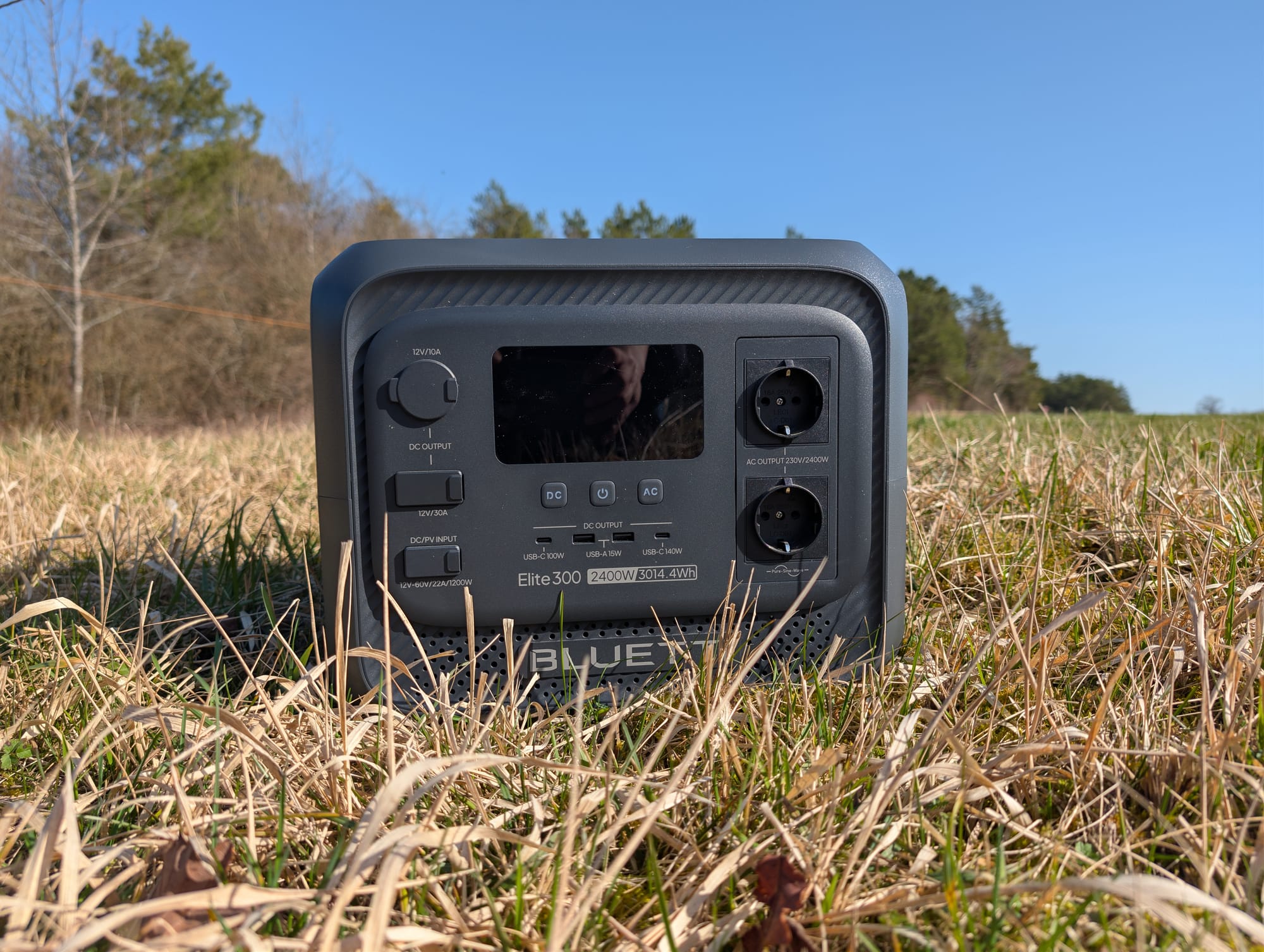
Bluetti Elite 300: key specifications
- Capacity: 3,014Wh (LiFePO4)
- Continuous AC output: 2,400W
- Power Lifting mode: runs resistive appliances rated up to 4,800W
- Lifespan: 6,000+ cycles to 80% capacity
- Weight: 26.3kg (58lb)
- Dimensions: 36.6 x 30.5 x 29.8cm (14.4 x 12 x 11.7in)
- Mains charging (230V version): full charge in about 1.6 hours according to Bluetti
- Solar input: up to 1,200W
- UPS switchover: 10ms or less
UK/EU vs US version: we tested the European 230V model, which has 2 AC outlets, 2 USB-C, 2 USB-A, a 12V car socket and a 12V/30A DC output. The US model runs on 120V and adds more AC outlets plus a TT-30R RV outlet, so you can plug an American RV straight into it.
A power station built for long off-grid stays
With its 3,014Wh, the Bluetti Elite 300 belongs to the category of stations designed for real independence. This is no longer a simple top-up battery, but an energy reserve that can provide home backup during a power cut, several days of autonomy in a van or campervan, or a very comfortable setup in a motorhome.
In practice, you can plan for continuous use without constantly watching the gauge.

What runtime can you expect from the Bluetti Elite 300?
The runtime of a power station always depends on how you use it: power drawn, time in use, number of appliances connected at once, and even the outside temperature. That is exactly why you should choose a power station around your real needs, not just the headline capacity.

Allowing for a real-world efficiency of around 85 to 90%, here are some runtime estimates, one appliance at a time:
- 12V fridge (50W): around 50 to 55 hours (before accounting for compressor cycling)
- Electric oven (2,000W): around 1h15 to 1h20
- Induction hob (1,800W): around 1h25 to 1h30
- Hairdryer (1,200W): around 2h10
- Electric heater (500W): around 5 hours
- Circular saw (1,400 to 1,600W): around 1h35 to 1h55 of continuous use (far longer in practice, as use is intermittent)
- Electric lawnmower (1,000 to 1,500W): around 1h45 to 2h40 depending on power and cutting load
- Electric griddle (2,000 to 2,400W): around 1h05 to 1h20
If you run several appliances at once, runtime drops accordingly. Both the screen and the Bluetti app show live consumption and remaining time, so you can adjust as you go.
Clearer data than on previous models
A real step forward in readability: where the remaining-time display used to be hard to interpret (with values like "24.2 h"), the screen now spells out the days, hours and minutes left.

Bluetti Elite 300 vs Elite 200 V2: about 940Wh more
Compared with the Elite 200 V2 we tested and use in our own motorhome, the difference is clear: the Elite 300 offers about 940Wh more capacity (3,014Wh vs 2,074Wh). For the same use, that means roughly 45% more runtime.

Interestingly, the Elite 300 does not have more continuous power: 2,400W against 2,600W for the Elite 200 V2. The gain is in capacity, not in output. If you mostly need power for high-draw appliances rather than long autonomy, the Elite 200 V2 is still a very strong choice: Elite 200 V2 (US) / Elite 200 V2 (UK).
2,400W continuous: what can it run?
With 2,400W of continuous output, the Elite 300 can run an electric oven, an induction hob, a kettle or a hairdryer, and even several appliances at once, as long as the combined draw stays under 2,400W.
A note for UK readers: many British kettles are rated at 3kW, above the Elite 300's 2,400W continuous limit. A lower-wattage travel kettle avoids the problem, or you can rely on Power Lifting mode (see below).
Also worth knowing: on the European version you will want an extension lead with several sockets, as the Elite 300 only has two AC outlets (230V).

Power Lifting mode: our kettle and hairdryer test
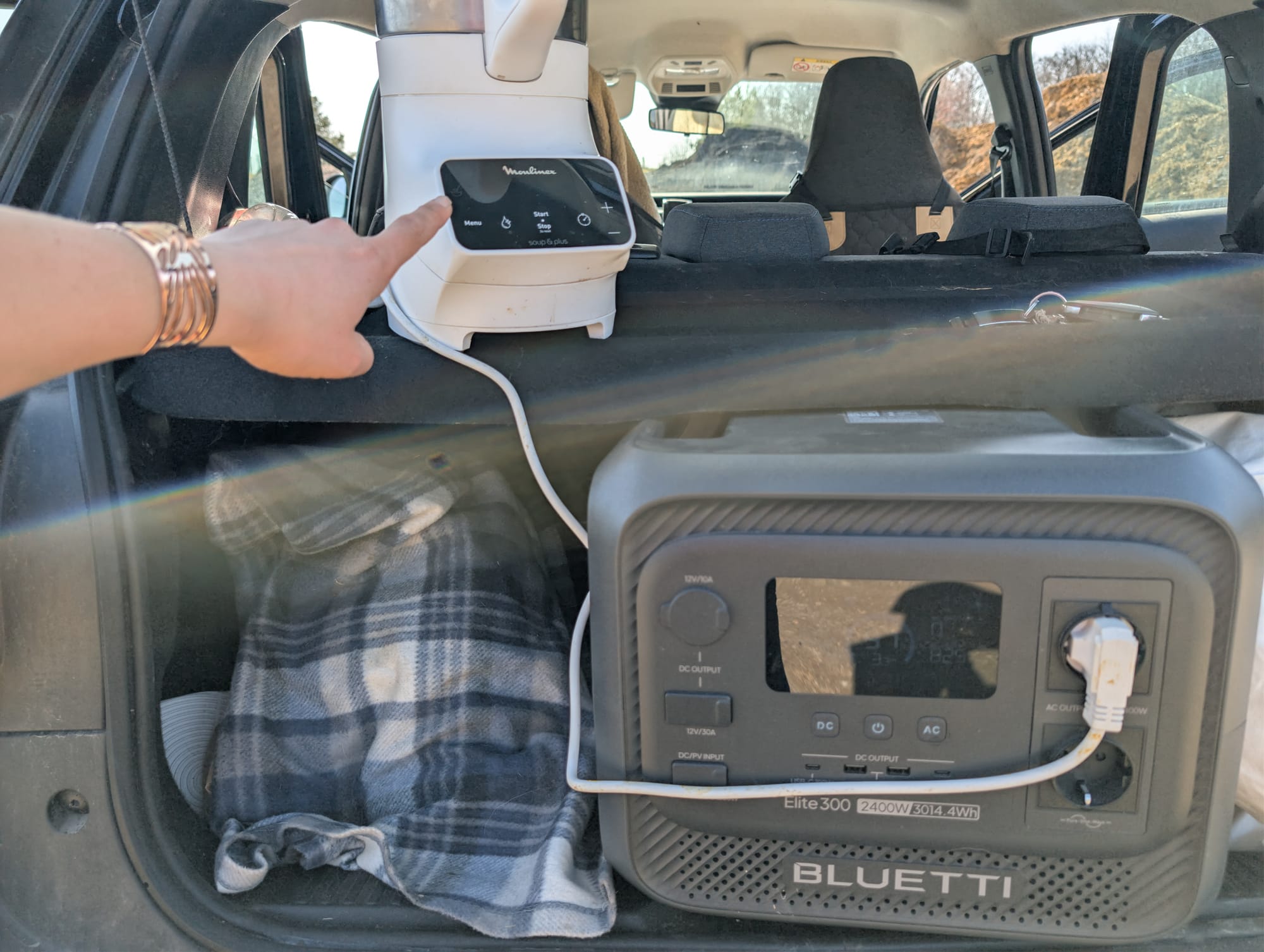
We wanted to push the test to the limit by running a hairdryer and a kettle at the same time.
In standard mode, switching on the hairdryer at medium power (1,300W) on top of the kettle made the battery cut out to protect itself. Switch on Power Lifting mode from the app, though, and the station takes the load.
How it works: Power Lifting lets resistive appliances such as kettles, hairdryers or heaters rated up to 4,800W in total keep running by lowering the voltage. The real output stays capped at 2,400W, so those appliances simply run at reduced power, a kettle takes a little longer to boil, for example. It is a clever safety net rather than extra power.
Also keep in mind that power does not change capacity: at that level of draw, runtime falls to around an hour.
Charging the Elite 300 from the mains
Like any power station, the Bluetti Elite 300 offers several charging options, which makes it versatile both on the road and at home.
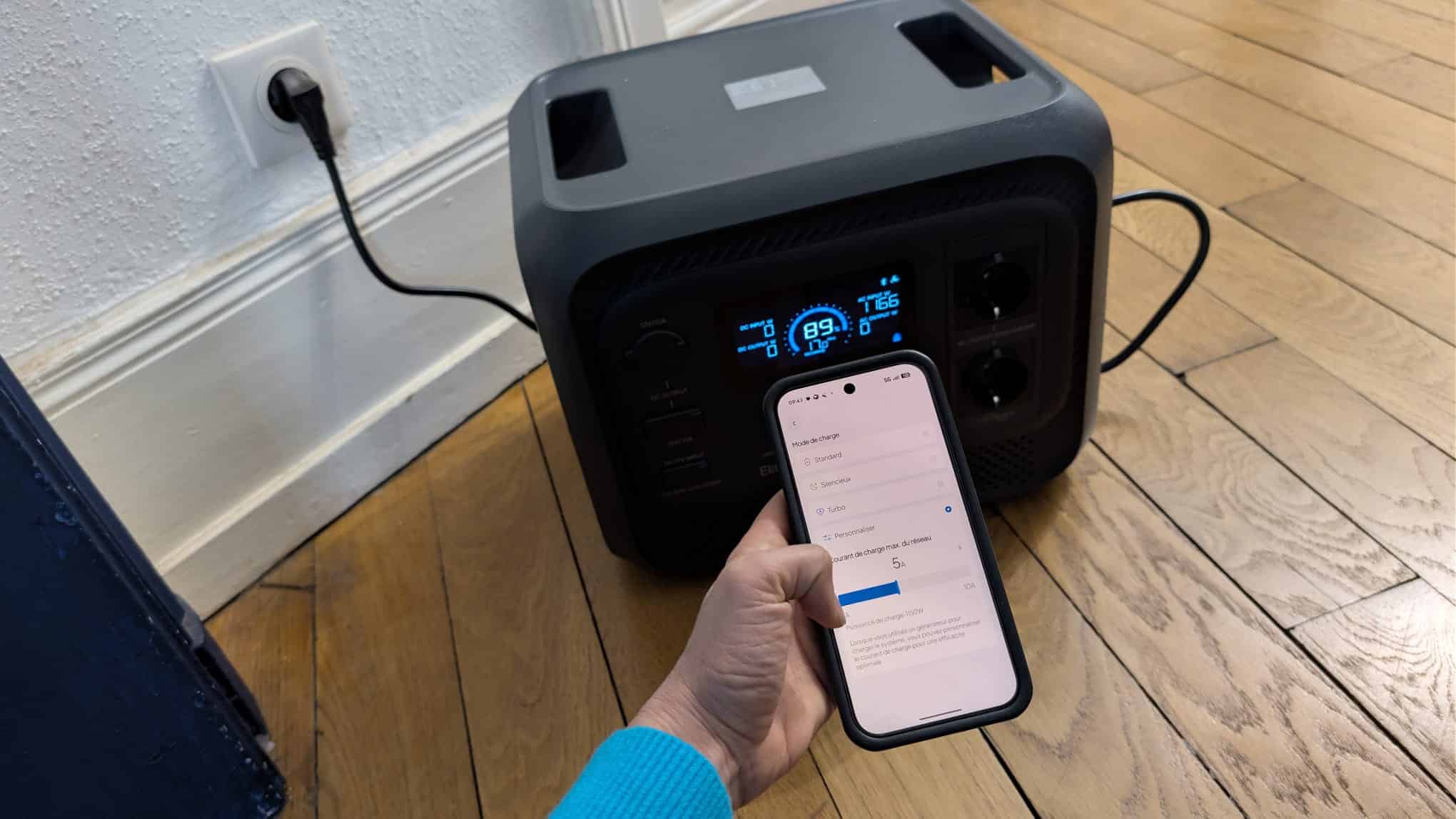
Charging from a 230V socket is the fastest option. Bluetti quotes a full charge in about 1.6 hours with its 2,300W AC input. In Turbo mode, our unit reached around 80% in about an hour. By default, the battery is set to standard (slower) charging, so remember to switch modes in the app when you are in a hurry.
Charging the Elite 300 with solar panels
The Elite 300 also supports solar charging, a real plus in a van, campervan or motorhome. Theoretical full-charge times in full sun:
- with around 600W of panels: 5 to 6 hours
- with 400W of panels: around 8 to 9 hours
- with 200W of panels: around 15 to 18 hours

These figures assume ideal conditions: maximum sunshine, perfect panel orientation and minimal losses. In practice, add around 15 to 20% depending on the weather, temperature and real-world efficiency. Solar is best used to top up the battery whenever conditions allow, rather than waiting for a full recharge.

Charging from the 12V socket or the alternator
Charging from a 12V cigarette lighter socket is possible but slow: at 60 to 120W depending on the vehicle, a full charge can take more than 24 hours. It is a top-up solution.
The Elite 300 is, however, compatible with Bluetti's alternator chargers, which charge the battery much faster while you drive. Make sure your vehicle's alternator can handle the extra load before installing one: Bluetti alternator charger (US) / Bluetti alternator charger (UK).

Weight and size: compact for 3kWh, but no lightweight
At 26.3kg (58lb), the Elite 300 is about 2kg heavier than the Elite 200 V2. That weight matters if you plan to move it often. We did the lifting ourselves for this test: carrying 26kg at arm's length is no picnic.

The Elite 300 is also slightly longer and about 5.5cm (2.2in) wider than the Elite 200 V2, though a little lower. In our motorhome, that was enough for it to no longer fit in the storage column we had set aside for our Elite 200 V2.
Even so, a semi-permanent installation in a van or motorhome makes sense given the capacity on board. For a battery of more than 3kWh, the Elite 300 remains remarkably compact compared with what is on the market across all brands.
Control via the Bluetti app
The Elite 300 can be controlled remotely through the Bluetti app, on iOS and Android. Over Bluetooth or Wi-Fi, you can monitor the charge level, switch the AC and DC outputs on or off, adjust the charging power, check your consumption history, and even wake the unit or set schedules.
That saves you from having to reach the station when it is tucked away in a locker or a technical cupboard, a real convenience in a motorhome.

How much does the Bluetti Elite 300 cost?
At the time of writing (October 2026), the Elite 300 is listed at around £1,499 in the UK and $1,099 to $1,199 in the US on Bluetti's official stores, depending on current promotions. Bundles with solar panels or an alternator charger are also available. Prices change often, so check the current deal: Bluetti Elite 300 (US) / Bluetti Elite 300 (UK).
How the Bluetti Elite 300 compares with the competition
With 3,014Wh, 2,400W continuous and 6,000+ cycles, the Elite 300 ranks among the most capable portable power stations. It beats models like the EcoFlow Delta 2 Max (US) / EcoFlow Delta 2 Max (UK) or the Anker Solix F2600 on capacity, and offers around 45% more runtime than the Elite 200 V2.
Stations with similar capacity, such as the EcoFlow Delta Pro (US) / EcoFlow Delta Pro (UK), the Anker Solix F3800 or the Bluetti Apex 300, are aimed more at home backup. They offer more modularity or raw power, but they are bulkier, heavier and usually more expensive. For a broader comparison, see our guide to the best portable power stations and our EcoFlow Delta 3 comparison.
Who is the Bluetti Elite 300 for?
The Elite 300 is a strong fit for campervan and motorhome owners, as well as tradespeople and mobile workers, who need long-lasting off-grid power for work or travel. In the US, its TT-30R outlet makes it particularly interesting for RV owners. Its weight and bulk make it a semi-permanent solution rather than a battery you would move every day.
Our verdict
If your priority is long autonomy on the road, the Elite 300 is a very compelling option: lots of capacity in a remarkably compact unit. That said, compare it with the Elite 200 V2, which is lighter, slightly more powerful in continuous output, cheaper, and already more than enough for most off-grid needs.
- What we liked: 3,014Wh in a compact body, Power Lifting mode for kettles and hairdryers, clear screen with runtime in days and hours, fast mains charging, complete app, TT-30R RV outlet on the US version
- What we liked less: 26.3kg (58lb) to lift, only two AC outlets on the European version, less continuous power than the Elite 200 V2, slow charging from a 12V socket
Frequently asked questions
How long does the Bluetti Elite 300 last on a charge?
It depends on what you run. With 3,014Wh and a real-world efficiency of about 85 to 90%, expect roughly 50 to 55 hours on a 50W 12V fridge, around 2 hours with a 1,200W hairdryer, or about an hour at very high draw.
How fast does the Bluetti Elite 300 charge?
From a 230V socket, Bluetti quotes a full charge in about 1.6 hours; in Turbo mode our unit reached around 80% in an hour. With 600W of solar in full sun, expect 5 to 6 hours. From a 12V car socket, more than 24 hours.
Can the Elite 300 run a kettle or an induction hob?
Yes, as long as the combined draw stays under 2,400W. For resistive appliances above that (such as a 3kW UK kettle), Power Lifting mode keeps them running at reduced power.
Bluetti Elite 300 or Elite 200 V2: which should you choose?
The Elite 300 adds about 940Wh (around 45% more runtime) but weighs about 2kg more, is wider, and has slightly less continuous output (2,400W vs 2,600W). For most off-grid travel, the Elite 200 V2 is plenty. Choose the Elite 300 if capacity is your priority.
How much does the Bluetti Elite 300 weigh?
About 26.3kg (58lb), with two carrying handles.
How much does the Bluetti Elite 300 cost?
Around £1,499 in the UK and $1,099 to $1,199 in the US on Bluetti's official stores at the time of writing, with frequent promotions.
Safe travels!
Pauline & Simon
N.B. This article contains affiliate links. If you are planning a purchase, using them helps us create new articles and videos. We receive a small commission at no extra cost to you.