
Shopping for a portable power station in 2026 can feel like getting lost in a jungle of names and numbers: River 3, Delta 3 Plus, AC180, Elite 300, Explorer 2000 v2… it's easy to lose the thread. Yet behind all those labels, three brands — EcoFlow (US) / EcoFlow (UK), Bluetti (US) / Bluetti (UK) and Jackery (US) / Jackery (UK) — share most of the market for portable power stations used in campervans, motorhomes and at the campsite.
We're Pauline and Simon, and we've been living and travelling in vans and motorhomes for over a decade. We've road-tested several of these units. Here we've put everything back on the table: a full 2026 comparison, brand by brand, with up-to-date prices, capacities, output power and our honest advice so you don't buy the wrong one.
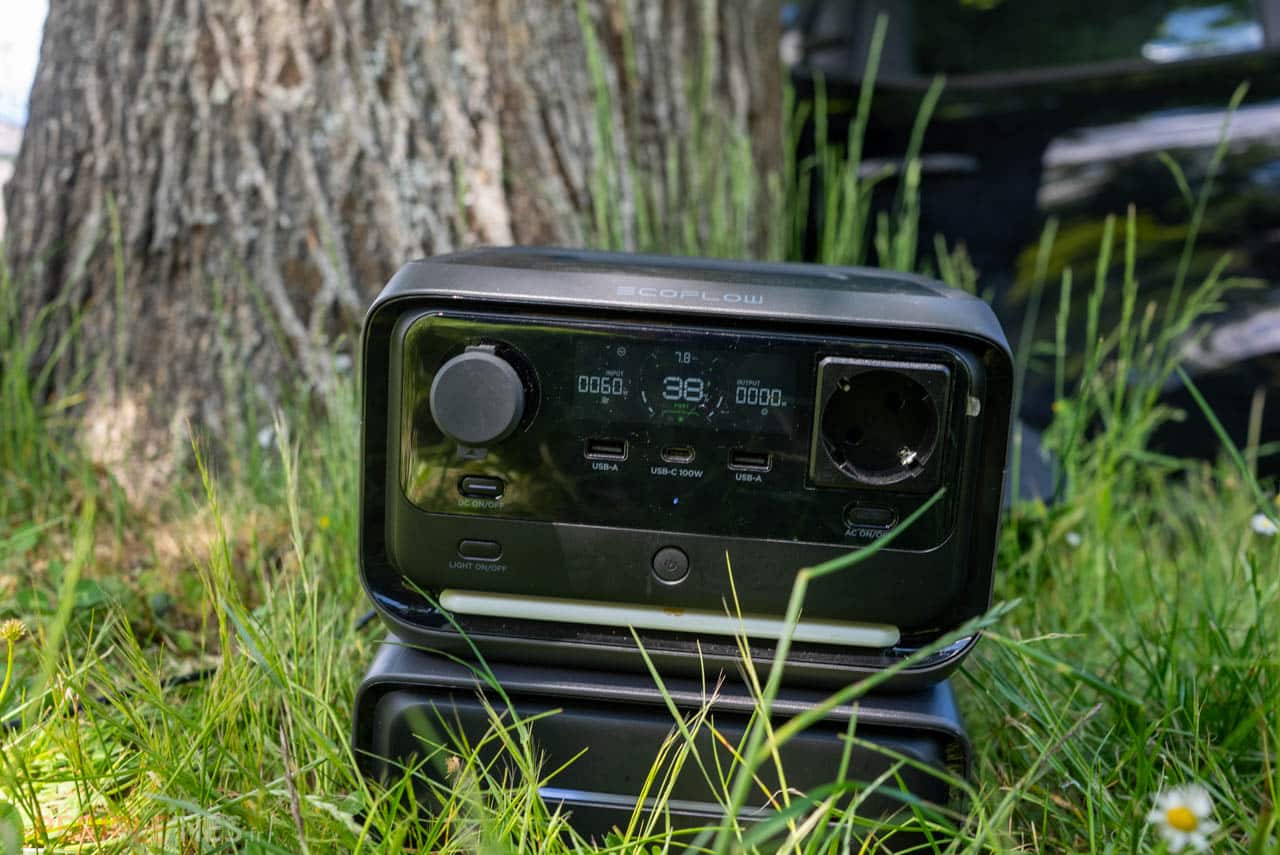
🎁 Our 3 exclusive discount codes on portable power stations
Valid on the official EcoFlow, Bluetti and Jackery sites — stackable with the brands' own running promotions.
| EcoFlow | −5% site-wide | PERIPLETIES | Visit EcoFlow US → Visit EcoFlow UK → |
| Bluetti | −5% site-wide | BLUETTIPERIP | Visit Bluetti US → Visit Bluetti UK → |
| Jackery | −5% site-wide | PERIPLETIES | Visit Jackery US → Visit Jackery UK → |
Codes valid outside the brands' own promotions. This box contains affiliate links: we earn a small commission on sales, at no extra cost to you.
What is a portable power station (and how is it different from a leisure battery)?
Sometimes called a "portable power station", sometimes a "solar generator", these large batteries let you run and recharge electrical appliances without being plugged into the mains. Thanks to their range of outputs — 230V mains sockets, USB-A and USB-C ports, a 12V car socket — they become a portable source of power you top up at home, while driving, or from the sun with solar panels.
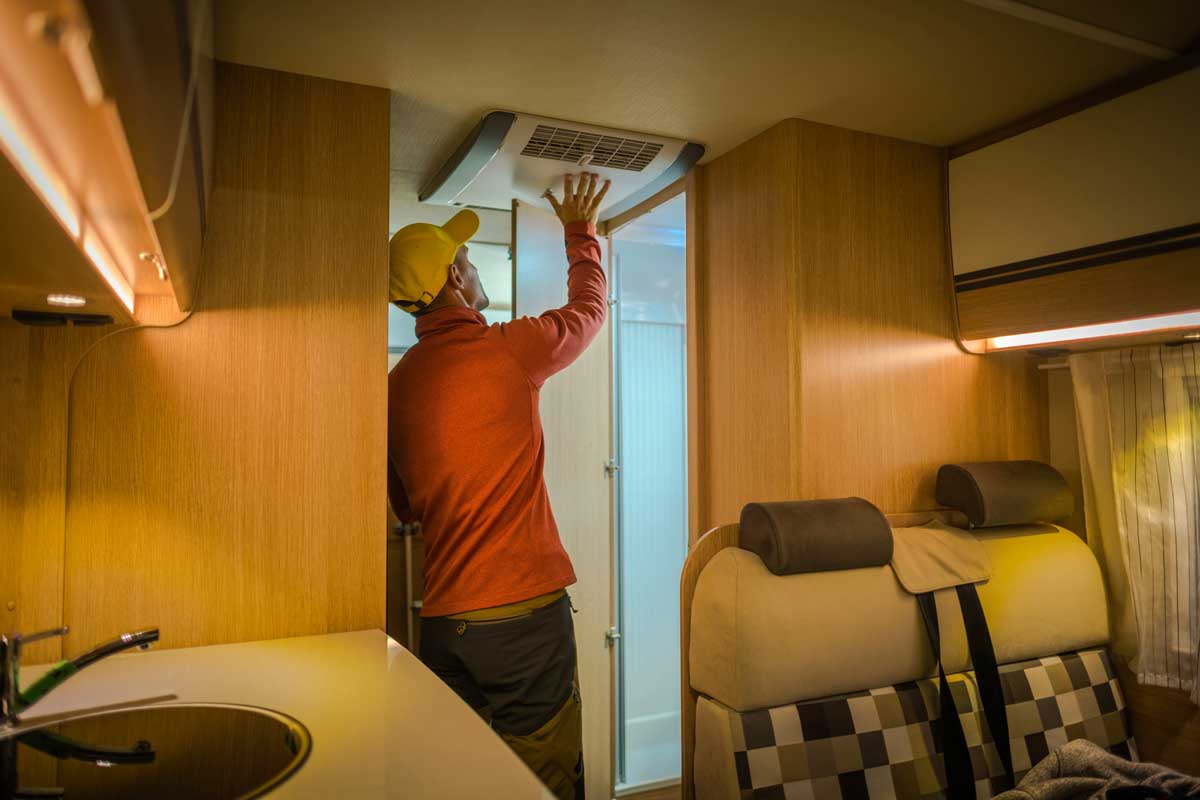
If you tour the UK or Europe, you'll already know the leisure battery fitted in your motorhome or campervan. A portable power station isn't a direct replacement for that fixed system — think of it as a flexible, plug-and-play complement (or, for van and car conversions, a complete off-grid solution in itself). You can lift it out, use it under an awning or in a tent, recharge it however you like, and take it home in winter.
That's exactly what you need when you're off-grid without an electric hook-up (EHU) — running a cool box, charging laptops and phones, powering a bit of lighting, and on the bigger models a kettle, a coffee machine or some tools. It's the kind of kit that makes a night on a quiet aire or a France Passion farm stop genuinely comfortable.
One thing to clear up: don't confuse these stations with pocket power banks (like the Jackery Explorer 100 Plus (US) / Jackery Explorer 100 Plus (UK), which only has USB outputs). In this guide we're talking about the stations with proper 230V mains sockets — the only ones that are truly versatile for life on the road.
How to choose a portable power station: the 6 things that actually matter
Before we dive into each range, here are the points to check. They're the difference between a battery that travels with you for a decade and a purchase you regret.
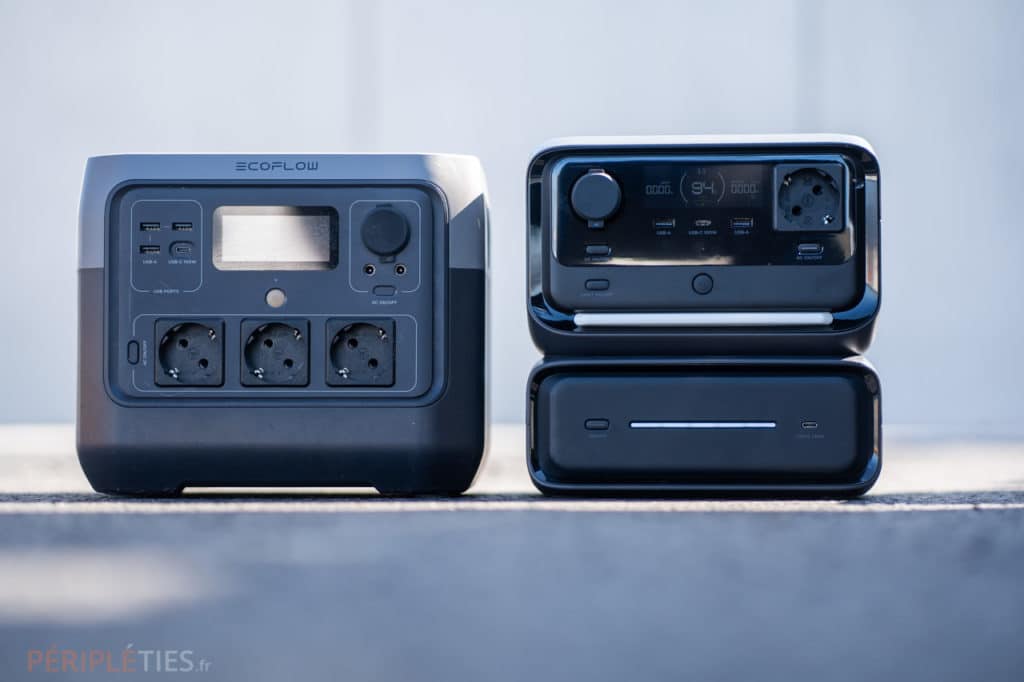
1. Capacity (in Wh). Your energy reserve. 250Wh covers a light weekend, 1,000Wh keeps a van going for a few days, and 3,000Wh+ is motorhome or home-backup territory. Our rule of thumb: aim for at least twice your estimated daily consumption.
2. Output power (in W). This decides which appliances you can run. Below 600W, forget the kettle or hairdryer. From 1,800W upwards, almost every everyday appliance works. The "surge" (peak) figure only matters for the brief spike when a motor starts up.
3. Battery chemistry. The good news in 2026 is that almost the entire range from all three brands has moved to LiFePO4 (lithium iron phosphate). It's safer, more stable and far more durable than the older lithium-ion.
4. Lifespan (in cycles). One cycle = one full charge. EcoFlow (US) / EcoFlow (UK) and Jackery (US) / Jackery (UK) quote 3,000–4,000 cycles; Bluetti (US) / Bluetti (UK) goes up to 6,000+ on its Elite series — potentially 15 years or more. On a battery you'll keep for the long haul, this matters as much as the price.
5. Weight and bulk. A 7kg station can be carried one-handed; a 30–40kg unit demands real thought about storage and securing it in the vehicle — not to mention the impact on your payload (the weight your motorhome is legally allowed to carry). Always check your vehicle's plate before adding a heavy unit.
6. Price per Wh. Our favourite way to compare objectively: divide the price by the capacity. The lower the figure, the better the deal. In this guide it ranges from about £0.42/Wh (the best value) to over £1/Wh (the small models, mechanically pricier per Wh).
The EcoFlow range in 2026
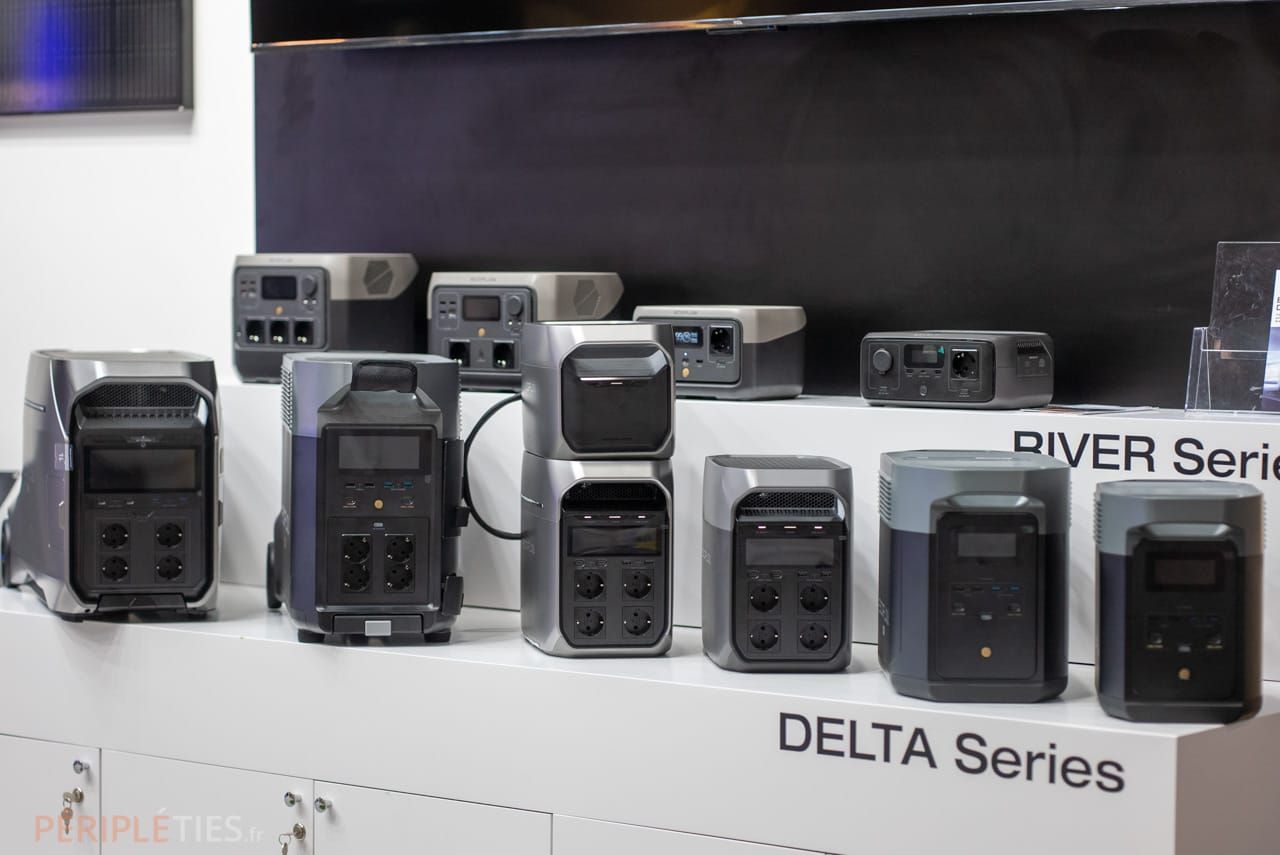
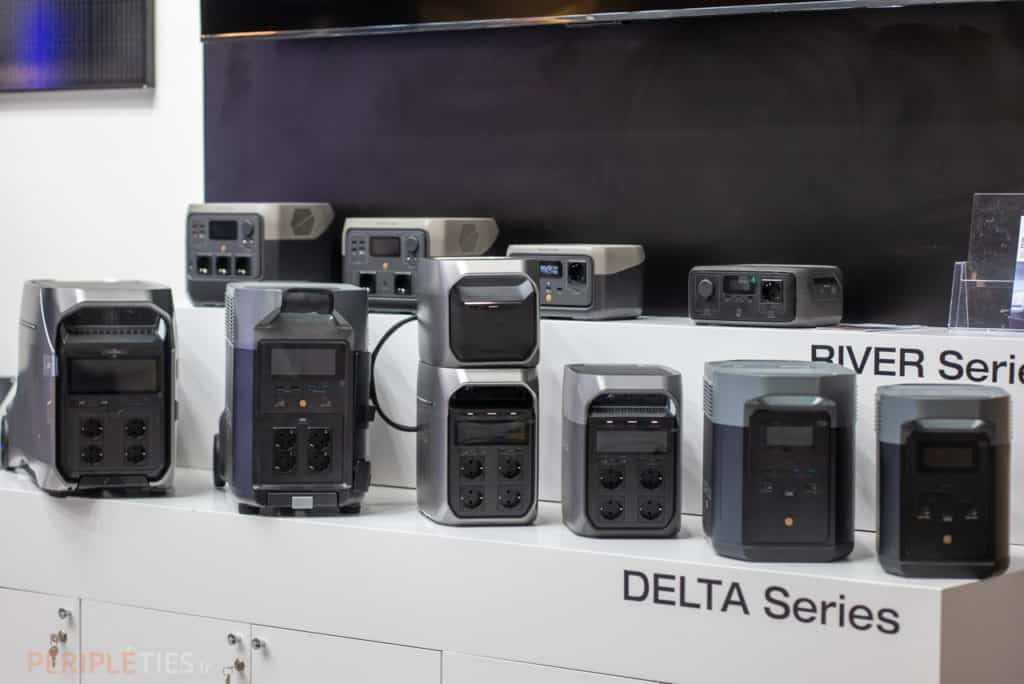
EcoFlow is still the best-known name in the sector, and its number-one selling point hasn't changed: ultra-fast charging. A Delta 3 Plus (US) / Delta 3 Plus (UK) recharges to 100% in under an hour on mains, where rivals often take longer. The range is still built around two families — River (US) / River (UK) (compact) and Delta (US) / Delta (UK) (power) — and in 2026 the River 3 (US) / River 3 (UK) and Delta 3 (US) / Delta 3 (UK) generations have moved the whole brand to LiFePO4.
The River series: compact and mobile
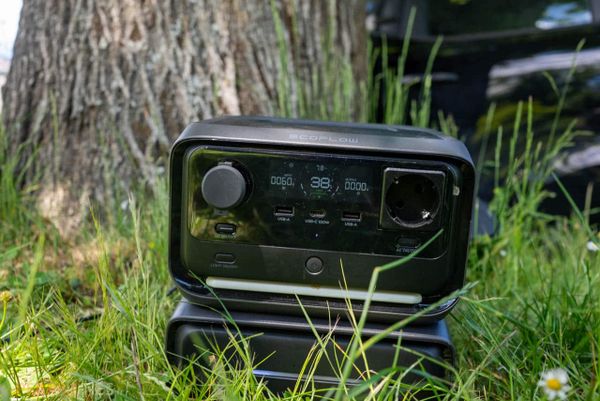
The River 3 (US) / River 3 (UK) (245Wh, 300W) is the smallest and most affordable: perfect as a top-up battery for a weekend under canvas, charging phones, lights and small kit. The River 3 Plus (US) / River 3 Plus (UK) (286Wh, 600W) steps up the power and becomes expandable, while the River 3 Max (US) / River 3 Max (UK) (572Wh) is our favourite of the series for camping: enough energy for a few days, featherweight (~6kg) and good value per Wh.
It's the one we always take with us in our car conversion to run the cool box, recharging as we drive and/or with a solar panel.
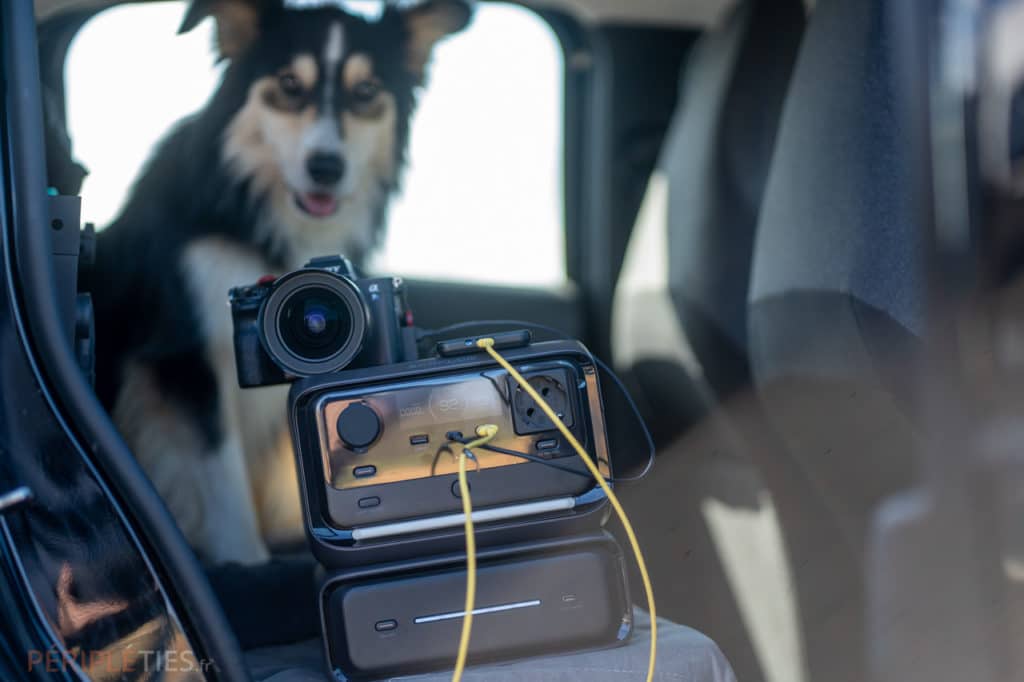
And the River 2 Pro, which we tested in our motorhome?
Before the River 3 generation arrived, we used the EcoFlow River 2 Pro (US) / EcoFlow River 2 Pro (UK) (768Wh, 800W, X-Boost up to 1,600W) extensively in our motorhome. We even took it all the way to Turkey and Georgia! Still available from most retailers in 2026, it's probably our overall favourite.
Why? Because it ticks almost every box: LiFePO4 chemistry with ~3,000 cycles (~10 years of use), a genuinely compact format (7.5kg, still one-hand portable), EcoFlow's signature fast charging, and a price that's stayed reasonable.
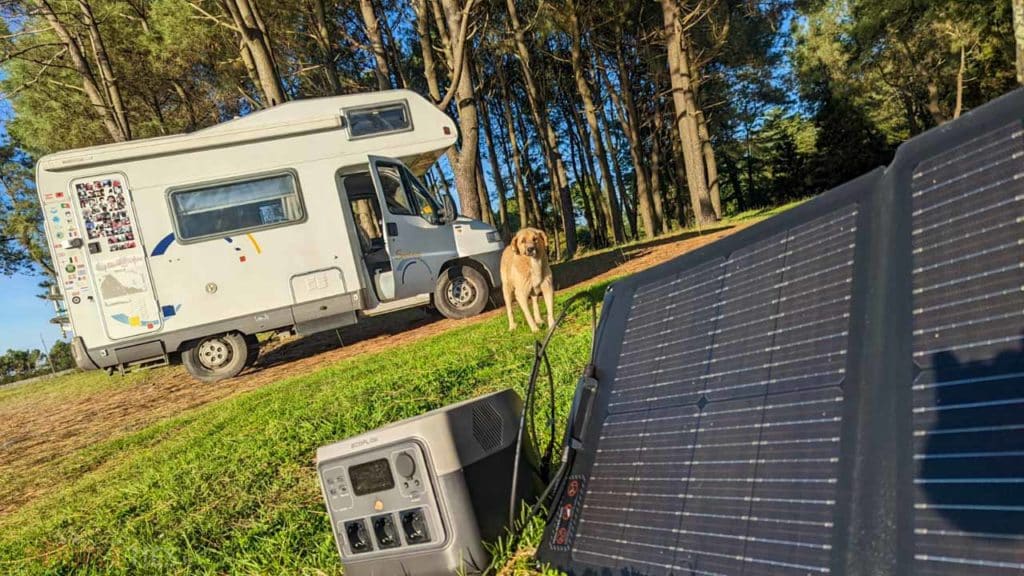
In use, it happily runs a laptop, a compressor cool box, drone and camera charging, and even handles power-hungry appliances in X-Boost mode (a blender, a small microwave). Camping in a tent or in a light van, that's plenty for 2–3 days of autonomy with a 160W–220W solar panel. If you want the detail — real measured runtime, solar charging, behaviour in a van.
The Delta series: power that follows you anywhere
Before the Delta 2 and Delta 3 generations, we ran the original EcoFlow Delta (US) / original EcoFlow Delta (UK)(1,260Wh, 1,800W, 2,200W surge) for several months in a van and a motorhome. It's the unit that first got us into the world of portable power stations. It's no longer sold on the official store, though.
The real downside of that first generation was its classic lithium-ion battery (not LiFePO4), with around 800 cycles — a much shorter life than the Delta 2 and Delta 3, which moved to LiFePO4 (3,000–4,000 cycles). If you spot the original heavily discounted or refurbished, it can still be a one-off bargain, but for a long-term investment we'd jump straight to the current generation.
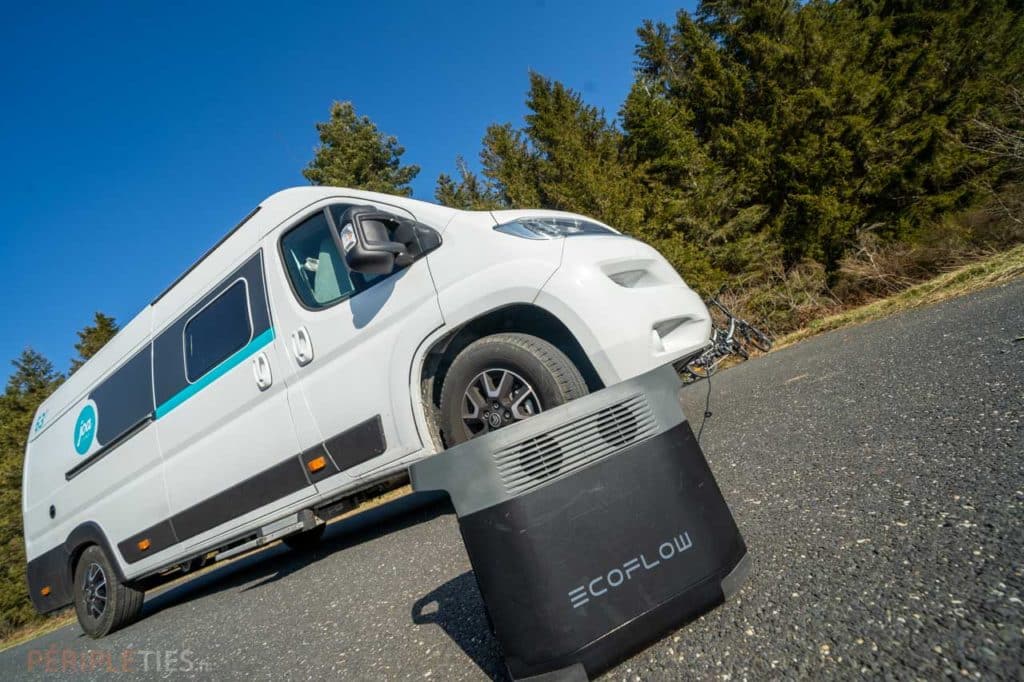
This is where it gets interesting for life in a converted vehicle. The Delta 2 (US) / Delta 2 (UK) (1,024Wh) remains, at around £459, one of the best deals on the market on price-per-Wh. The Delta 3 (US) / Delta 3 (UK) and Delta 3 Plus (US) / Delta 3 Plus (UK) add even faster charging, more cycles (4,000) and expandability up to 5kWh — handy if your needs grow.
Above those, the Delta 2 Max (US) / Delta 2 Max (UK) and Delta 3 Max (US) / Delta 3 Max (UK) (2,048Wh) enter "proper motorhome" territory: 2,400W of power, enough to run almost everything. At the very top, the Delta Pro (US) / Delta Pro (UK) (3,600Wh) and Delta Pro 3 (US) / Delta Pro 3 (UK) (4,096Wh) play in the home-backup league — with weights of 45–51kg that, as ever, stretch the meaning of "portable".
Our verdict on EcoFlow
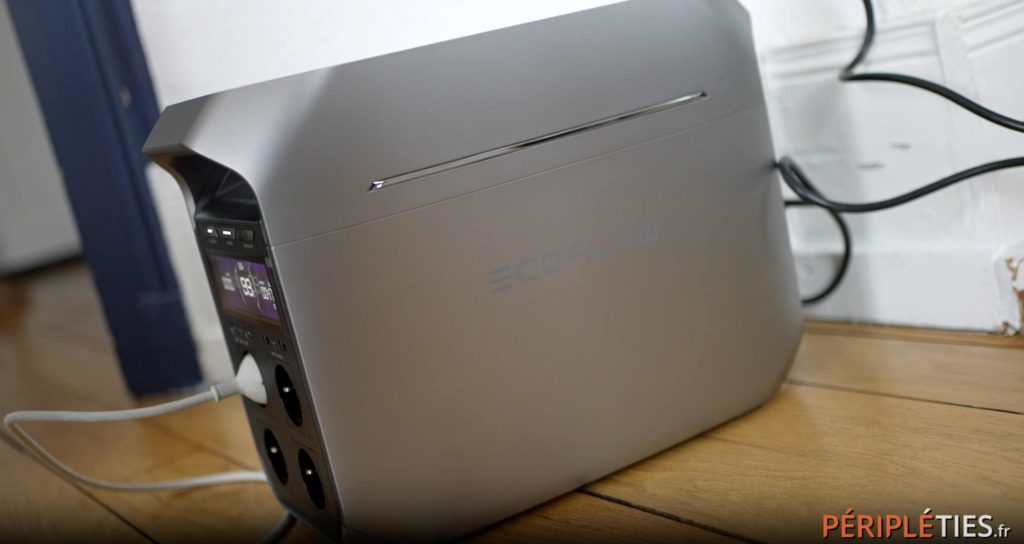
EcoFlow is probably the most versatile brand, with the fastest charging and the most complete ecosystem (solar panels, an alternator charger (US) / alternator charger (UK) to top up while driving, the app, a cool box, a portable air conditioner). The Delta 2 and Delta 3 are excellent choices for a van or panel van. They carry easily thanks to a handle on each side — but be warned, their shape can make them awkward to stow neatly in some spaces.
The Bluetti range in 2026
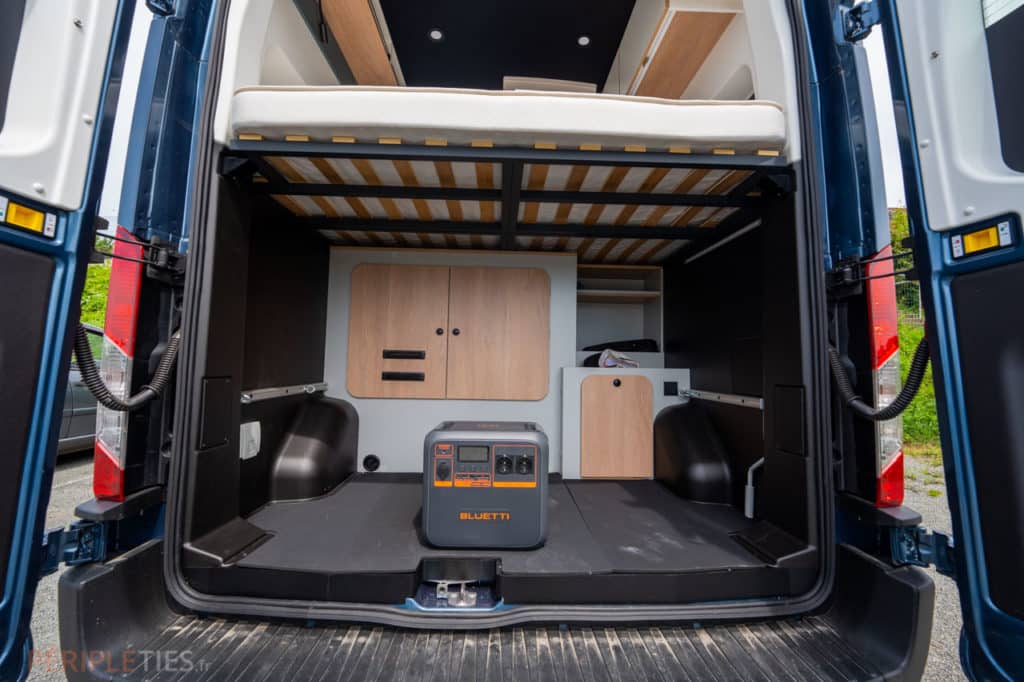
Bluetti is arguably the brand that shook up the market most in 2025–2026, thanks to its Elite series. The line-up now reads as two families: the AC series (classic, often expandable) and the Elite series (newer, more compact and rated for 6,000+ cycles — around 17 years of daily use).
The AC series: the value-for-capacity champion
The AC2A (US) / AC2A (UK) (205Wh) is the entry ticket, ideal as a top-up solution under £200. The AC70 (US) / AC70 (UK) (768Wh, 1,000W) targets camping and light vans. But the real star of this series is the AC180 (US) / AC180 (UK) (1,152Wh, 1,800W): at around £499, it's one of the best prices-per-Wh in this whole comparison (£0.43/Wh), with enough power for a kettle or hairdryer. For a lot of vanlifers, it's the smartest pick.
Above it, the AC200L (US) / AC200L (UK) (2,048Wh, 2,400W) is the strongman of the series, expandable beyond 8kWh and fitted with a dedicated motorhome socket. The AC240P (US) / AC240P (UK) stands out with its IP65 rating (splash- and dust-resistant), built for the outdoors. Finally, the modular AC300 + B300K (US) / AC300 + B300K (UK) and AC500 + B500K (US) / AC500 + B500K (UK) systems are aimed at home backup: the AC500 head delivers 5,000W and accepts multiple batteries.
The Elite series: compact and built to last
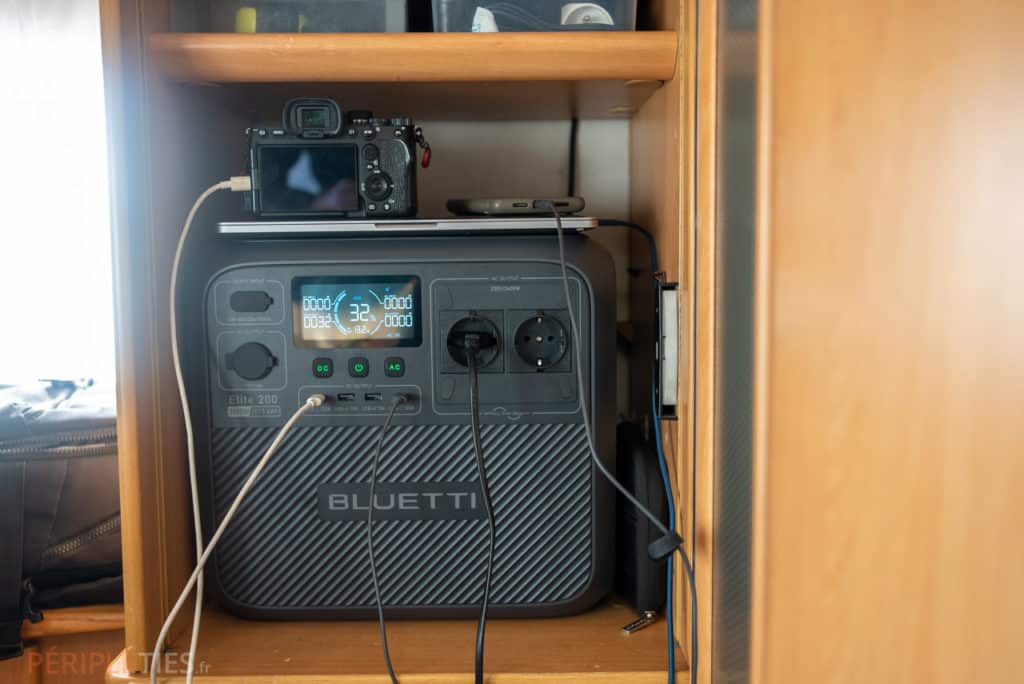
This is the big news. The Elite 100 V2 (US) / Elite 100 V2 (UK) (1,024Wh) offers four mains sockets and an excellent weight-to-power ratio. The Elite 200 V2 (US) / Elite 200 V2 (UK) (2,074Wh, 2,600W) is impressive for its compactness (2kWh in the format of a 1kWh unit) and its quietness (we measured 16dB under light load) — it slots perfectly into the rear cupboard of our motorhome.
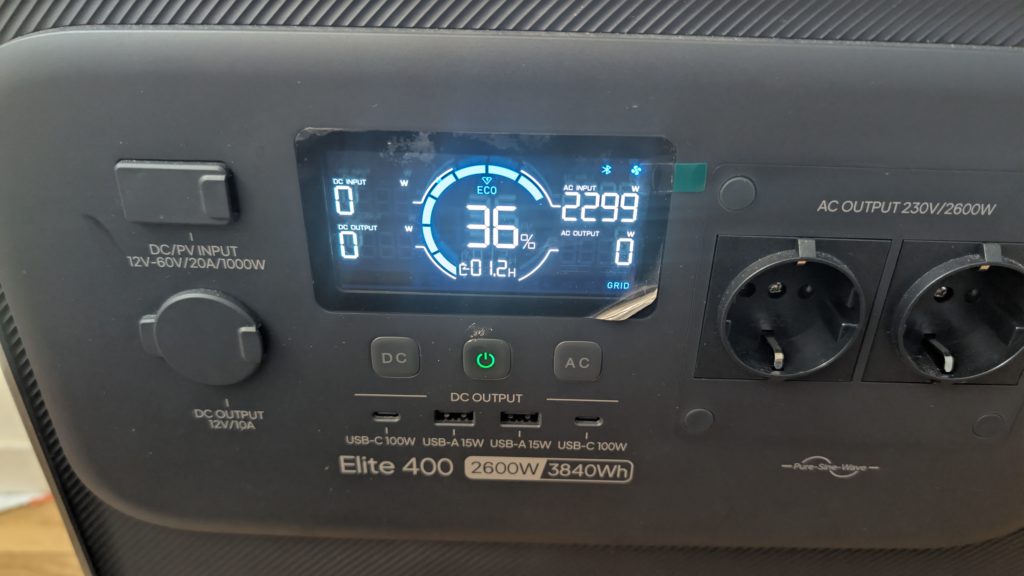
The Elite 300 (US) / Elite 300 (UK) (3,014Wh) is certified as the most compact 3kWh station on the market, and the Elite 400 (US) / Elite 400 (UK) (3,840Wh) plays the very-large-reserve card on wheels (just as well, as it weighs 39kg!).
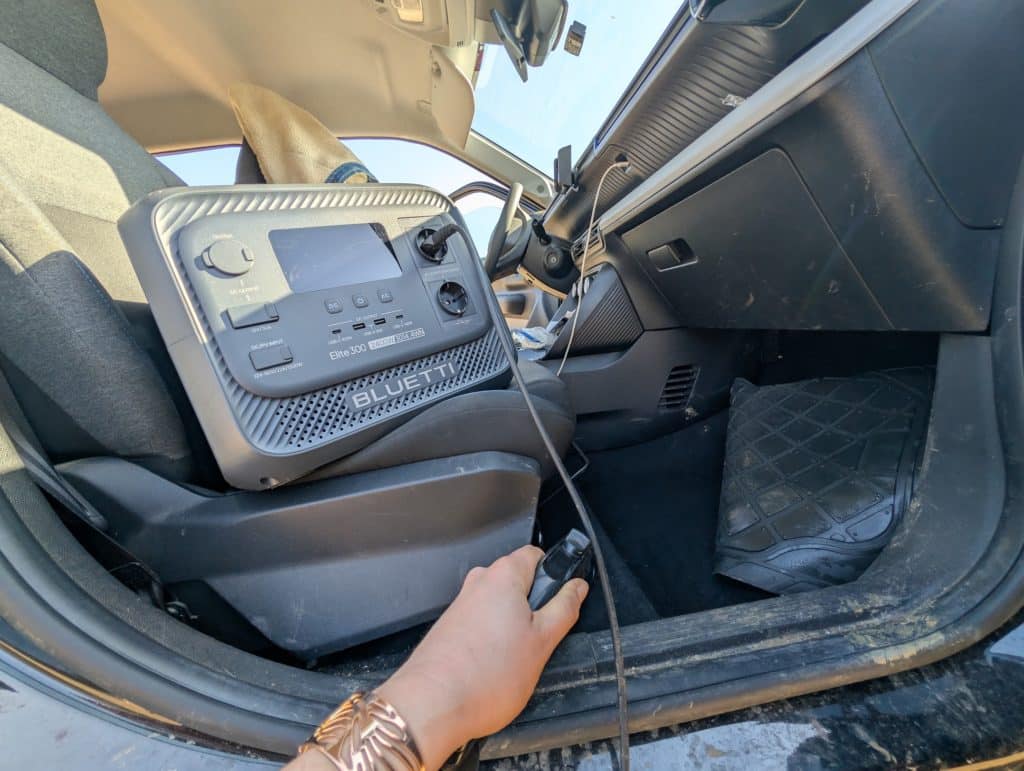
We tested both of these out on the road: our full reviews are available for the Bluetti Elite 400 (US) / Bluetti Elite 400 (UK) and the Bluetti Elite 300 (US) / Bluetti Elite 300 (UK). Our conclusion? They're excellent batteries — provided you genuinely need that much autonomy. For simple weekends, they're oversized and too heavy to lug around.
Our verdict on Bluetti
The best value-for-money-and-weight on the AC series right now (the AC180 leading the way), and the best lifespan on the market on the Elite series. If you plan to keep your battery for a very long time, Bluetti has a rock-solid argument. See also our Bluetti AC180P review (US) / Bluetti AC180P review (UK).
The Jackery range in 2026
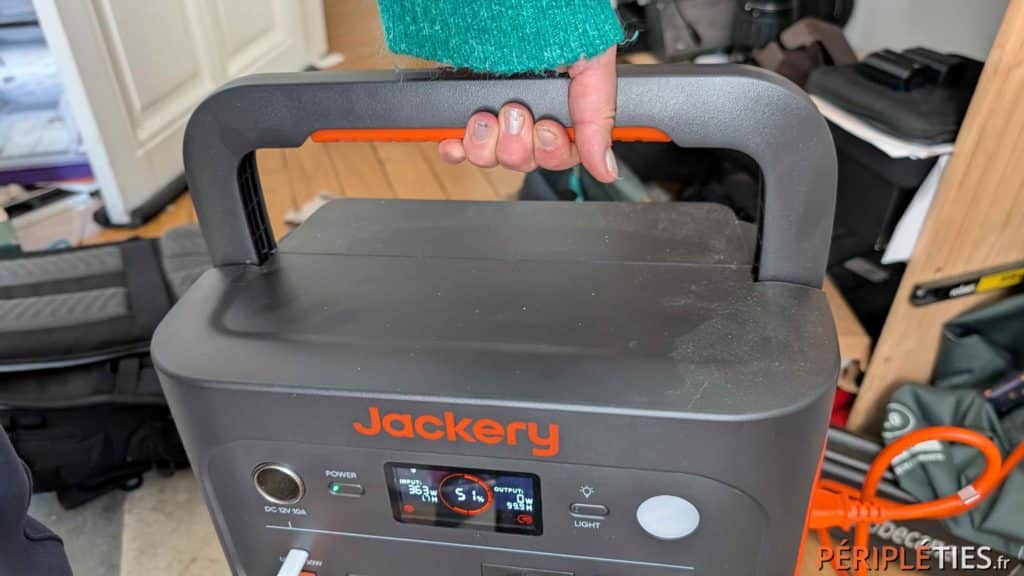
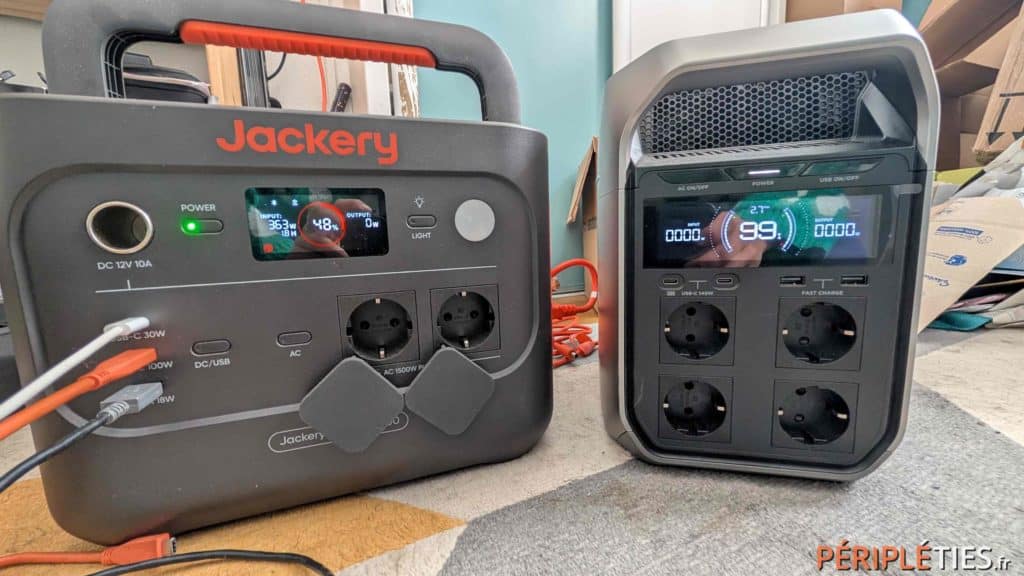
Jackery is the American pioneer of the sector (since 2012), and stayed on classic lithium-ion for a long time. The brand made a real turn with its v2 generation, which finally moves to LiFePO4, gets more compact and charges noticeably faster. Alongside it, the Plus series gathers the expandable models.
From compact to all-rounder
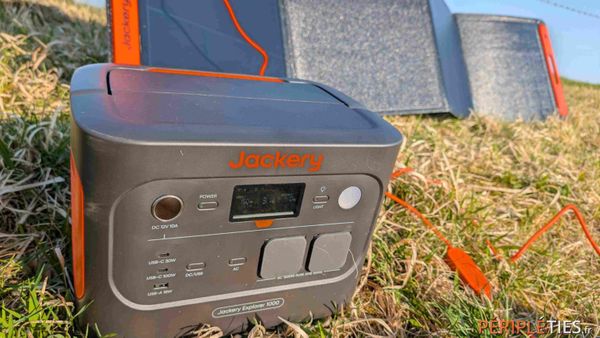
The Explorer 100 Plus (US) / Explorer 100 Plus (UK) (99Wh) sits at the edge of our scope: with no mains socket, it's really a large power bank. The Explorer 240 v2 (US) / Explorer 240 v2 (UK) (256Wh) and Explorer 300 Plus (US) / Explorer 300 Plus (UK) (288Wh) are the true entry-level compacts. The Explorer 500 v2 (US) / Explorer 500 v2 (UK) (512Wh) benefits from a good lifespan (6,000 cycles).
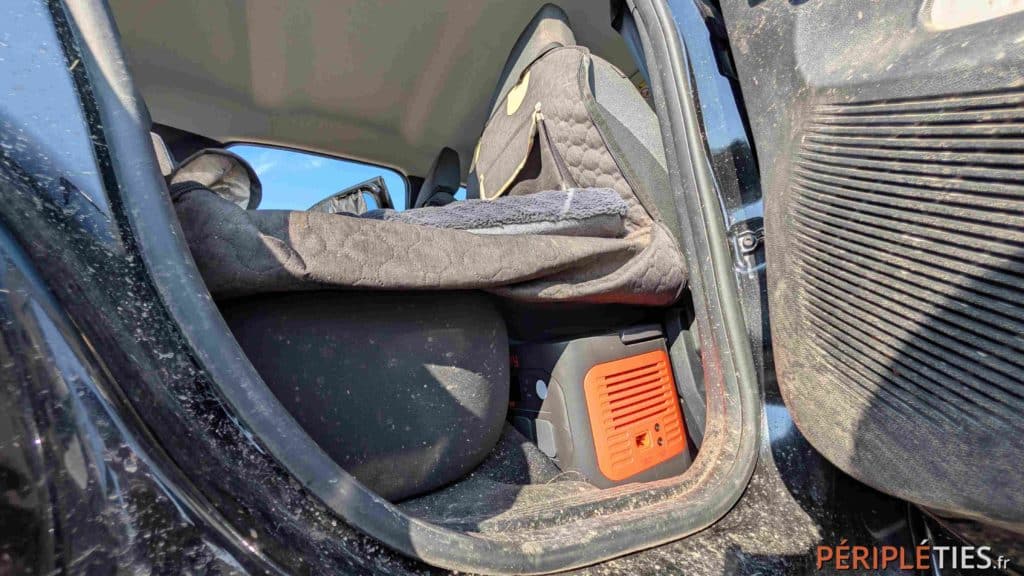
The heart of the range is the Explorer 1000 v2 (US) / Explorer 1000 v2 (UK) (1,070Wh, 1,500W): at around £699, its price-per-Wh (£0.65) is among the most competitive in its class, making it an excellent choice for everyday van life. The Explorer 1000 Plus (US) / Explorer 1000 Plus (UK) (1,264Wh) is more powerful in an even more compact format.
The big models
The Explorer 2000 v2 (US) / Explorer 2000 v2 (UK) (2,042Wh, 2,200W) is our Jackery favourite: thanks to CTB technology borrowed from electric vehicles, it's 41% lighter than a typical 2kWh LiFePO4 station (just 17.9kg) — a real plus in a motorhome. The Explorer 2000 Plus focuses on expandability (up to ~12kWh), while the Explorer 3000 v2 (US) / Explorer 3000 v2 (UK) (3,072Wh) and Explorer 5000 Plus (5,040Wh) chase maximum autonomy and home backup.
One recurring niggle on the v2 generation: the solar input is capped at 400W on the Explorer 1000 v2 and 2000 v2, where rivals often accept more. If you plan to rely heavily on solar, that's worth checking.
Our verdict on Jackery
A brand that has caught up nicely. The Explorer 1000 v2 and 2000 v2 are excellent products — light and well-priced. We're left a little wanting on solar input and expandability for the "v2" (non-Plus) models.
We'll also be honest: overall, we find the products a touch less polished — they sound a little plastic, and the buttons feel slightly flimsy. We're not certain it would all hold up under heavy, long-term use, and we're keen to hear from owners who've run them hard. Of the three brands here, Jackery feels the most "budget" — a long way from EcoFlow's design (you have to like orange!) and Bluetti's solidity. But that has to be weighed against the price, which is hard to beat.
EcoFlow, Bluetti or Jackery: which one for your trip?
Rather than crowning one "winner", here are our recommendations by situation — because we get asked constantly: "Which portable power station should I buy?" Our answer is always the same: "It depends on your needs!"
For a weekend camping in a tent
A compact unit is more than enough: EcoFlow River 3 (US) / EcoFlow River 3 (UK), Bluetti AC2A (US) / Bluetti AC2A (UK) or Jackery Explorer 240 v2. Light, inexpensive, easy to carry.
For a campervan or small panel van
Aim for the all-rounder segment around 1,000Wh. Our top trio: Bluetti AC180 (US) / Bluetti AC180 (UK) (best price), EcoFlow Delta 2 (US) / EcoFlow Delta 2 (UK) or Delta 3 (US) / Delta 3 (UK) (fastest charging), Jackery Explorer 1000 v2 (US) / Jackery Explorer 1000 v2 (UK) (lightest). Hard to go wrong with any of the three.
For a motorhome
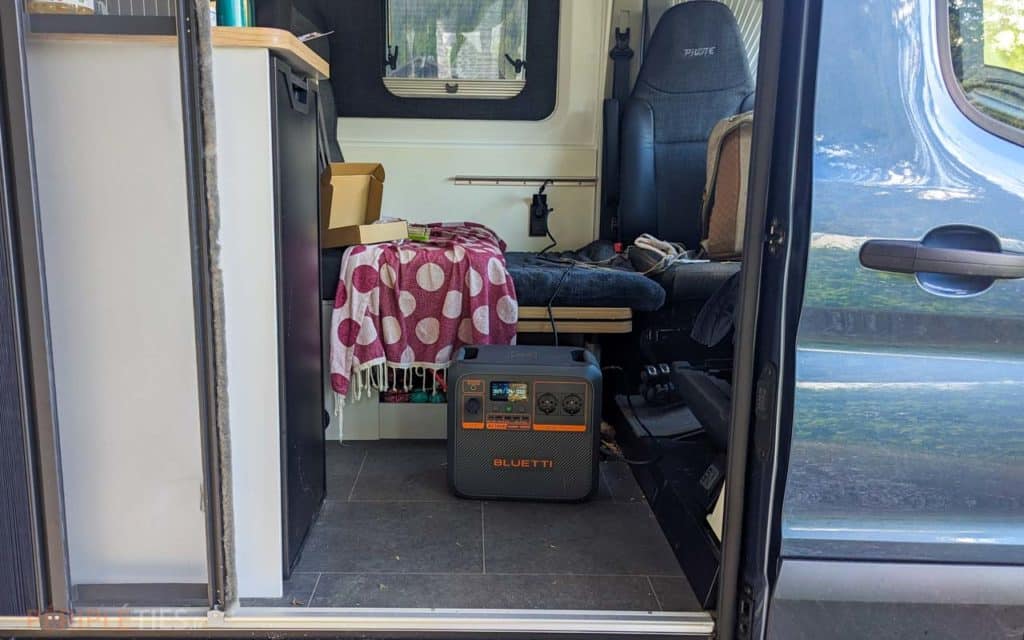
Step up to high capacity (2,000Wh and above). The EcoFlow Delta 3 Max and Bluetti AC200L (US) / Bluetti AC200L (UK) offer power and expandability; the Jackery Explorer 2000 v2 (US) / Jackery Explorer 2000 v2 (UK) wins on weight; the Bluetti Elite 200 V2 (US) / Bluetti Elite 200 V2 (UK) on compactness and lifespan. Check the space in your garage/locker and the vehicle's payload.
For mixed home + travel use / home backup
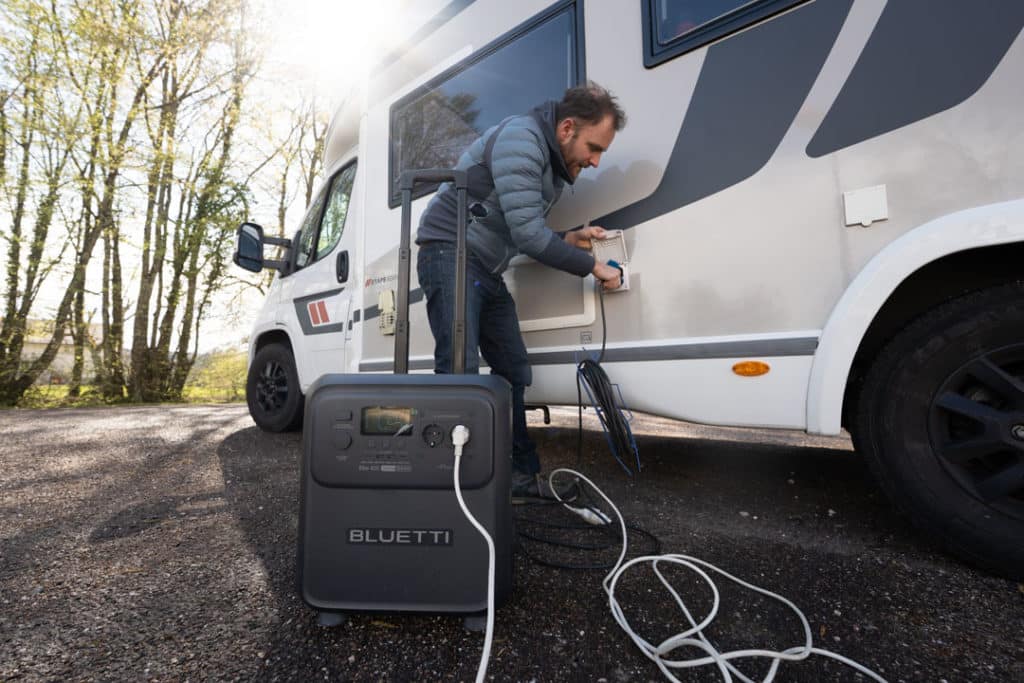
The territory of the big units: Bluetti Elite 300 (US) / Bluetti Elite 300 (UK) or Elite 400 (US) / Elite 400 (UK), EcoFlow Delta Pro (US) / EcoFlow Delta Pro (UK) / Delta Pro 3. Modular systems make real sense here if you want to grow capacity later.
If lifespan is your priority — clear advantage to Bluetti and its Elite series (6,000+ cycles), followed by the EcoFlow Delta 3 and Jackery v2 generations (4,000 cycles).
If fast charging is your priority — advantage EcoFlow, which has built its name on it.
If budget is your priority — watch the price-per-Wh: the Bluetti AC180, EcoFlow Delta 2 and Jackery Explorer 1000 v2 are regularly the best deals, especially during sales.
Our picks by budget
- Under £250: EcoFlow River 3 (US) / EcoFlow River 3 (UK) or Bluetti AC2A (US) / Bluetti AC2A (UK) — to get started and tide you over.
- Around £450–700: Bluetti AC180 (US) / Bluetti AC180 (UK), EcoFlow Delta 2 (US) / EcoFlow Delta 2 (UK) or the River 2 Pro (US) / River 2 Pro (UK) — perfect for van life.
- Around £900–1,400: Bluetti Elite 200 V2 (US) / Bluetti Elite 200 V2 (UK) or Jackery Explorer 2000 v2 (US) / Jackery Explorer 2000 v2 (UK) — accessible high capacity.
- £1,400 and up: Bluetti Elite 300 (US) / Elite 400 (US) / Bluetti Elite 300 (UK) / Elite 400 (UK) or EcoFlow Delta Pro 3 (US) / EcoFlow Delta Pro 3 (UK) — autonomy without compromise.
Whatever you choose, pair it with solar panels (all three brands offer them): that's what turns a simple battery into genuine energy independence.
Full portable power station comparison 2026
Below is the current line-up across all three brands, sorted by brand and increasing capacity. All listed models use LiFePO4 chemistry. Prices are current UK retail prices observed in June 2026 (brand UK stores and Amazon UK) — this is a heavily promotional market and prices fall sharply during seasonal sales and Black Friday, so always check the current price before buying. Read "£/Wh" as: the lower, the better the capacity-for-money. ★ marks the best £/Wh of each brand.
| Model | Capacity | Power | Surge | Cycles | Weight | Exp. | Price (approx.) | £/Wh |
|---|---|---|---|---|---|---|---|---|
| EcoFlow | ||||||||
| River 3 | 245 Wh | 300 W | 600 W | 3,000 | 3.55 kg | No | £189 | 0.77 |
| River 3 Plus | 286 Wh | 600 W | 1,200 W | 3,000 | ~4.5 kg | Yes | £259 | 0.91 |
| River 3 Max | 572 Wh | 600 W | 1,200 W | 3,000 | ~6.1 kg | Yes | £369 | 0.64 |
| Delta 2 | 1,024 Wh | 1,800 W | 2,400 W | 3,000 | ~12 kg | Yes | £459 | 0.45 ★ |
| Delta 3 | 1,024 Wh | 1,800 W | 3,600 W | 4,000 | ≤12.5 kg | Yes | £549 | 0.54 |
| Delta 3 Plus | 1,024 Wh | 1,800 W | 3,600 W | 4,000 | ≤12.5 kg | Yes | £699 | 0.68 |
| Delta 2 Max | 2,048 Wh | 2,400 W | 3,100 W | 3,000 | ~23 kg | Yes | £959 | 0.47 |
| Delta 3 Max | 2,048 Wh | 2,400 W | 3,600 W | 4,000 | ~21 kg | Yes | £1,099 | 0.54 |
| Delta Pro | 3,600 Wh | 3,600 W | 7,200 W | 3,500 | ~45 kg | Yes | £2,999 | 0.83 |
| Delta Pro 3 | 4,096 Wh | 4,000 W | ~6,000 W | 4,000 | ~51 kg | Yes | £3,399 | 0.83 |
| Bluetti | ||||||||
| AC2A | 205 Wh | 300 W | 600 W | 3,000+ | 3.6 kg | Yes | £159 | 0.78 |
| AC70 | 768 Wh | 1,000 W | 2,000 W | 3,000+ | ~10 kg | No | £449 | 0.58 |
| AC180 | 1,152 Wh | 1,800 W | 2,700 W | 3,500 | 16 kg | Yes | £499 | 0.43 |
| Elite 100 V2 | 1,024 Wh | 1,800 W | 3,600 W | 6,000+ | ~11.5 kg | No | £429 | 0.42 ★ |
| AC200L | 2,048 Wh | 2,400 W | 3,600 W | 3,500 | 28.3 kg | Yes | £999 | 0.49 |
| AC240P · IP65 | 1,843 Wh | 2,400 W | 3,600 W | 3,500+ | ~21.5 kg | Yes | £1,199 | 0.65 |
| Elite 200 V2 | 2,074 Wh | 2,600 W | 3,900 W | 6,000+ | 24.2 kg | No | £899 | 0.43 |
| Elite 300 | 3,014 Wh | 2,400 W | ~3,600 W | 6,000+ | ~30 kg | No | £1,399 | 0.46 |
| Elite 400 | 3,840 Wh | 2,600 W | 5,200 W | 6,000+ | 39 kg | No | £1,699 | 0.44 |
| Jackery | ||||||||
| Explorer 100 Plus (USB) | 99 Wh | 128 W | — | 3,000+ | 0.9 kg | No | £99 | 1.00 |
| Explorer 240 v2 | 256 Wh | 300 W | 600 W | 3,000+ | 3.6 kg | No | £199 | 0.78 |
| Explorer 300 Plus | 288 Wh | 300 W | 600 W | 3,000+ | ~3.75 kg | No | £249 | 0.86 |
| Explorer 500 v2 | 512 Wh | 500 W | 1,000 W | 6,000 | 5.7 kg | No | £449 | 0.88 |
| Explorer 600 Plus | 632 Wh | 800 W | 1,600 W | 4,000 | ~7.3 kg | No | £449 | 0.71 |
| Explorer 1000 v2 | 1,070 Wh | 1,500 W | 3,000 W | 4,000 | 10.8 kg | No | £699 | 0.65 ★ |
| Explorer 1000 Plus | 1,264 Wh | 2,000 W | 4,000 W | 4,000 | ~14.5 kg | Yes | £999 | 0.79 |
| Explorer 2000 v2 | 2,042 Wh | 2,200 W | 4,400 W | 4,000 | 17.9 kg | No | £1,399 | 0.69 |
| Explorer 2000 Plus | 2,042 Wh | 3,000 W | 6,000 W | 4,000 | ~27.9 kg | Yes | ~£1,499 | 0.73 |
| Explorer 3000 v2 | 3,072 Wh | 3,600 W | ~7,200 W | 4,000 | ~38 kg | No | £2,199 | 0.72 |
| Explorer 5000 Plus | 5,040 Wh | 7,200 W | — | 4,000 | ~60 kg | Yes | TBC | — |
LiFePO4 chemistry on all listed models. ★ = best £/Wh of each brand. Modular kits (EcoFlow Delta Pro Ultra, Bluetti AC300/AC500) not listed — see the sections above. Prices: current UK RRPs (June 2026) from brand UK stores / Amazon UK; smaller models indicative and frequently discounted.
FAQ — Portable power stations 2026
Which is the best brand: EcoFlow, Bluetti or Jackery?
There's no single "best" brand. EcoFlow (US) / EcoFlow (UK) excels at fast charging and its ecosystem, Bluetti (US) / Bluetti (UK) at value and lifespan, Jackery (US) / Jackery (UK) at lightness and simplicity. The right choice depends on your use and budget.
What capacity do I need for a campervan or motorhome?
For a campervan, a station around 1,000Wh covers most uses (cool box, laptops, lighting, charging). For a motorhome or long trips with bigger appliances, aim for 2,000Wh and up. The rule: at least twice your estimated daily consumption.
LiFePO4 or lithium-ion: what's the difference?
LiFePO4 (lithium iron phosphate) is safer, more stable and far more durable (3,000 to 6,000+ cycles, versus often 500 to 800 for classic lithium-ion). In 2026, nearly every recent model from all three brands is LiFePO4 — it's become the standard.
Can I recharge these batteries while driving?
Yes — via the 12V car socket (slow) or, far more efficiently, via a dedicated alternator charger (US) / alternator charger (UK) offered by the brands. You can also recharge from the mains and from solar panels. The basic cables are usually included.
Are the prices in this article up to date?
No — they're indicative figures observed in 2026. This market is highly promotional: prices drop sharply during seasonal sales and Black Friday. Always check today's price and confirm UK availability before buying.
So — which portable power station has caught your eye for 2026? If you're still torn, drop us your questions in the comments and we'll be happy to help.
Safe travels! 👋 Pauline & Simon
N.B. This article contains affiliate links. If you're planning a purchase, going through them (and using our discount codes) earns us a small commission at no extra cost to you — and helps us keep publishing our articles and videos for free.
You might also like
 Pauline & Simon